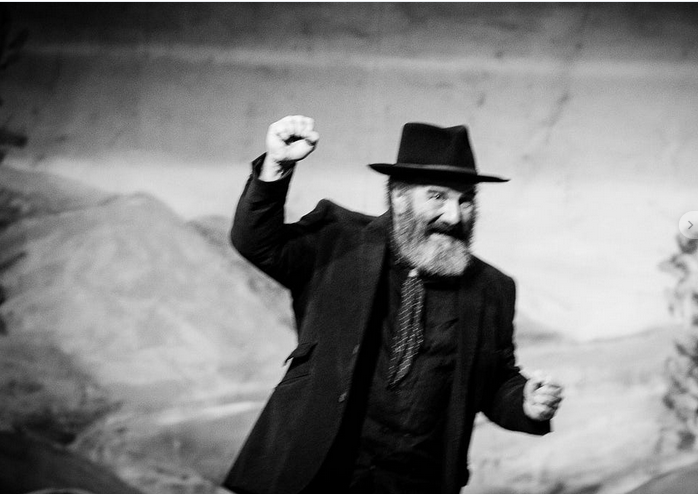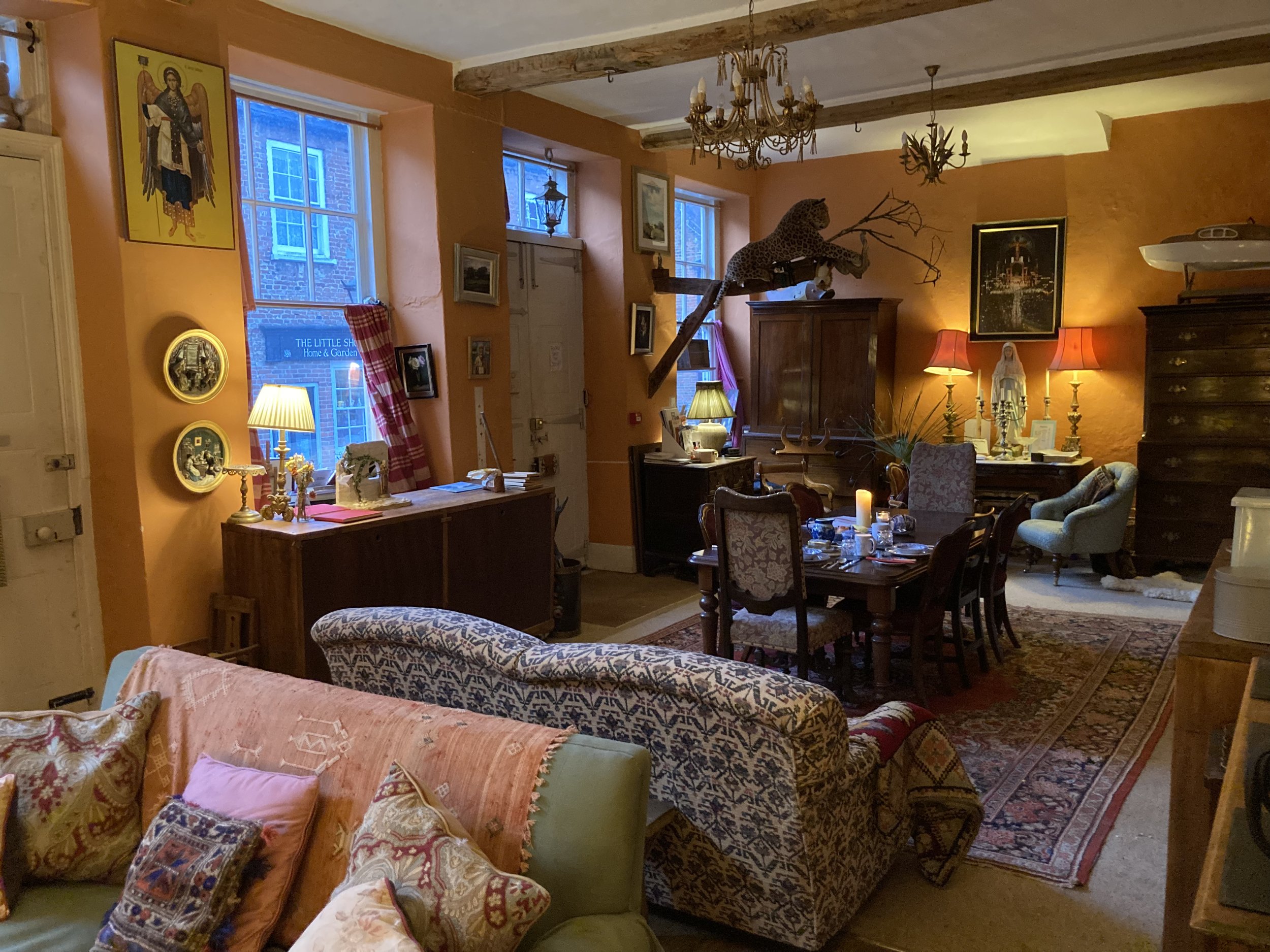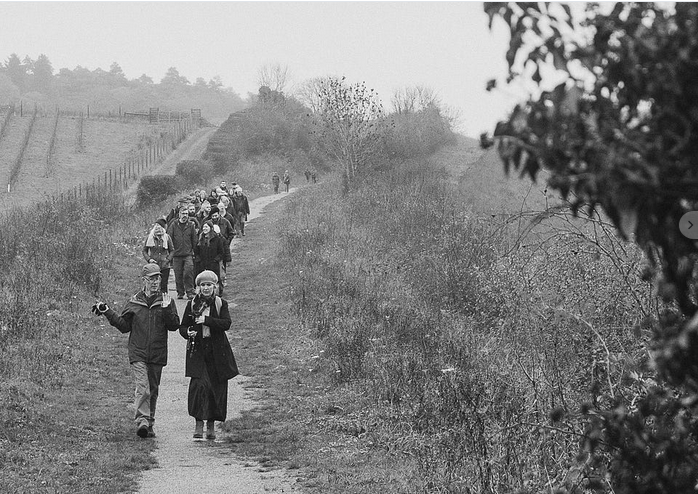
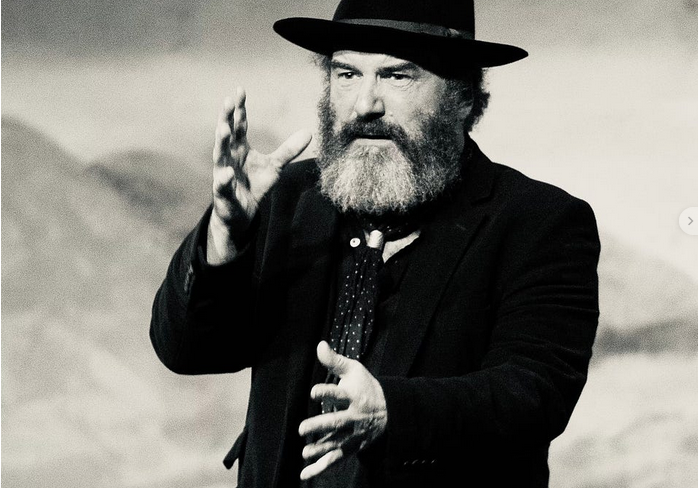
Those that made it through the storm: pilgrims to the Slipper Chapel led by my sister Anna. All photography Charlotte Bromley Davenport.
It’s a funny old world when the notion of a pilgrimage seems oddly radical, but last weekend at Walsingham, that was how it felt.
And we got our work cut out for us: anyone that made it likely wrestled Storm Claudia all day Friday just trying to get into Norfolk. It was about eight hours all in from Devon, and it’s fair to say I was a little deranged by arrival. I met old companions for a fat-headed, creamy Guinness in the back room of The Bull as we stared wide eyed and compared harrowed notes on the buffeting winds, scandalous detours and endless sheets of black rain. We had friends coming in from Canada, Holland, Scotland and all over, so we were praying them safe through the fury.
Take Courage
I was also Keeper of the Keys at St Seraphim’s Orthodox chapel, so in the swirling dark of early evening I was shown the ropes by Joanna – a friendly face – in the rock’n’rolling weather. That little chapel would provide me with tremendous, prayerful solace in the good natured but relentless bustle of the weekend. After a tossing and turning night I was heartened to see a few of us had actually made it through the weather and were gathered for a little pilgrim walk up to the Slipper Chapel.
From Henry III onwards Walsingham became a major shrine in Northern Europe, and a place visited by Kings, Queens and a steady stream of folk looking for peace, healing and depth of feeling. It was a name familiar to Christians all across Europe. Pilgrimages were of course good for business: inn keepers, shoemakers, boatmen to name but three all felt the benefit. There was a route from Shoreditch all the way to Walsingham, roads often being repaired by charitable work from the Religious Houses.
The Milky Way was known as the ‘Walsingham Way’, because the stars were meant to illuminate the pilgrim paths, known as ‘Greenways’. This was a period when the very roads of England were made holy by crosses going far back as Anglo-Saxon times. Some marked their way to shrines, needed when crop was high across the fields and you couldn’t see a thing. There was estimated to be more than five thousand crosses accompanying our tracks and roads at one point.
Well, like pilgrims of olde, we eyed each other friendly-like and prepared to walk to the Slipper Chapel.
My sister Anna gave a beautiful welcome and some reasoning for what we were about to do, and then off we all shuffled, the day suddenly much calmer, and the fields shimmering bright with all that fallen rain. Orthodox, Catholics, Protestants, and all sorts of folk simply seeking a deeper life.
I managed to find a bed for a couple of hours, and then it was time to be back at the Parish Hall and for the wider day to begin. Spotting my mother, father, brother, sister, heroic nephews and one beautiful niece in the assembled horde brought a delighted smile to my face.
Kernow Class: Lucy Cooper
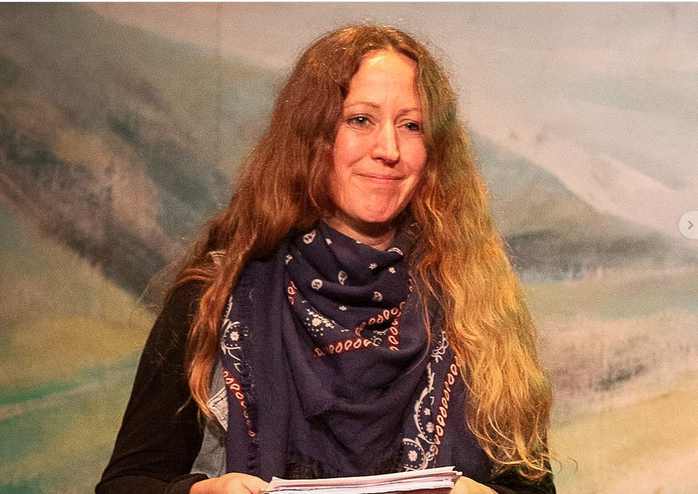
First up we had Lucy Cooper giving us some wider context for the whole notion of pilgrimage. Lucy is a fabulous writer, and also editor at the small press Cista Mystica. She walked us through some of her own considerable experience of ‘intentional strolling’ (maybe I just created a new phrase), and gave us all a lovely flavour of the west of Britain. Afterwards we chatted for a little while around the strange rebirth of interest in Christianity, and the urgency of our times. In the absence of my old friend Paul Kingsnorth I talked a little about the abiding notion of the Machine, and the possibility of being an Angel in the Machine ourselves. How do we move from the Machine to the Merrie?
Small Intentioned Steps Matter
Please don’t mistake this for me assuming one stomp across some soggy English fields eradicates the endlessly displayed and often terrifying spiritual turbulence of our age. But even so, one has to direct one’s feet somewhere, and this is, after all, Good News.
When you are lost in the forest it is tiny little breadcrumbs, small intentioned steps, that can lead you home. Circling darkness, and only focusing on circling darkness can lead to absolute paralysis. The weird titillation of paranoia. Drink some freshly squeezed orange juice, put on a James Brown record, spend an hour polishing your shoes. These things help.
I repeated something at the Merrie I wrote here a few weeks ago – the Devil hates a hand-made life.
Demons Want To Be Needed. Don’t be a life coach for a Demon’s self-esteem issues. If you want to disturb a Demon, a Machine, or a Monster, think about making a hand-made, human-sized life. Sometimes things are simpler than we may think. Find the Angel in the Machine, not just the Demon. Be the Angel in the Machine if you can. It’s radical to be a pilgrim.
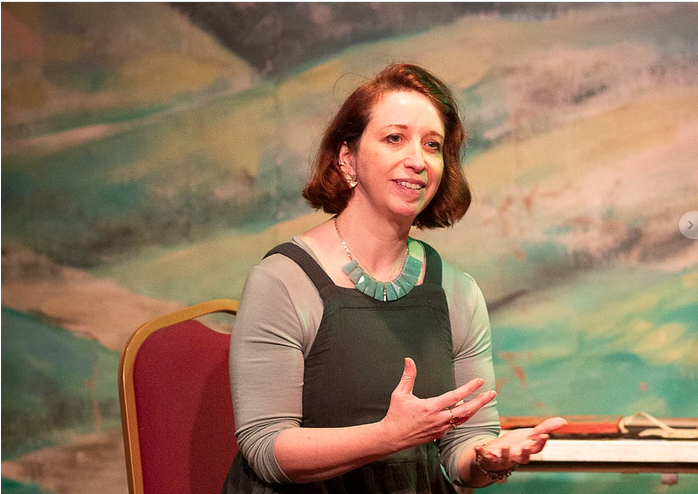
The artist Heather Pollington picked this thread up talking about her relationship to art and religion and place. Hugely experienced, she brought with her little glimpses of her work over the years on various very well known movies, and talked about the need to actually be able to create things we can hold in our hand. I was reminded of words she wrote recently here on Substack:
My own search for The Merrie has taken me on quite a path over the last few years. I’ve yearned for pre reformation church in England filled with the kind of things that Martin speaks of. I’ve struggled with the Protestant Reformers who destroyed many of the places and art objects that I long to see and visit. The journey eventually led me to Eastern Orthodoxy where this kind of integration between church, art, village and forest still exists.
This year, on the Feast of the Annunciation, having spent now hours in splendid Orthodox liturgies in various languages, I started to yearn for a service in English. I found a wonderful one in Shrewsbury one bright Spring morning crowned with daffodils. Hearing the chanting in my own native language, I felt almost moved to tears – a deep sense of home and belonging. Then, as often happens in the Christian life, I heard the word ‘hypocrite’ ringing in my ears. Suddenly I felt very close to those sixteenth-century Protestants and ashamed of my naivety. I’ve come to realise that everyone is yearning for the incarnation, we might just be looking for it in different ways.
The point I’m making is, there’s no going back. As Martin says, it is not a re-enactment festival, we are not in the business of nostalgia. So how do we find a way to rekindle something for the modern age? If there are embers, where do we look for them and what do we do?
Back at the ARC conference earlier this year I sat with renowned iconographer and liturgical designer Aidan Hart and we talked about a dream of our own. To find an old pilgrim route in England and build a small but beautiful ‘gem-like’ chapel. Inspired by Blake’s poem, it might be called the ‘Jerusalem Chapel’ an earthy vision of the Heavenly Jerusalem in the green hills of England. That evening I shared the idea with Martin Shaw and asked him, but what reliquary could we have? Martin had the wonderful invitational idea of the reliquary of the saints to come. At the moment our chapel is still a vision, but soon there’ll be drawings then by the Grace of God, one day we might actually be Making Merrie.
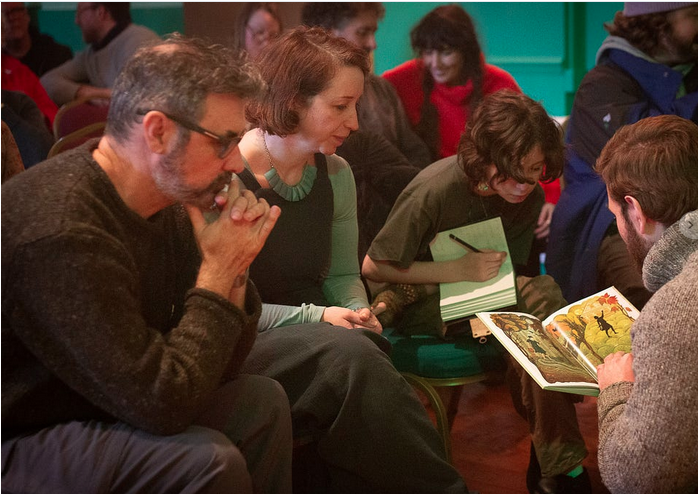
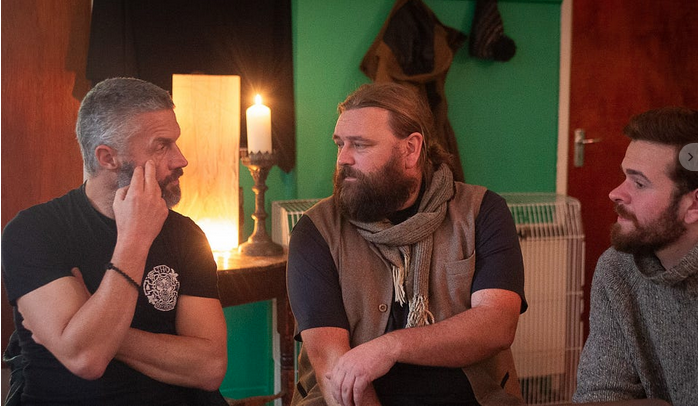
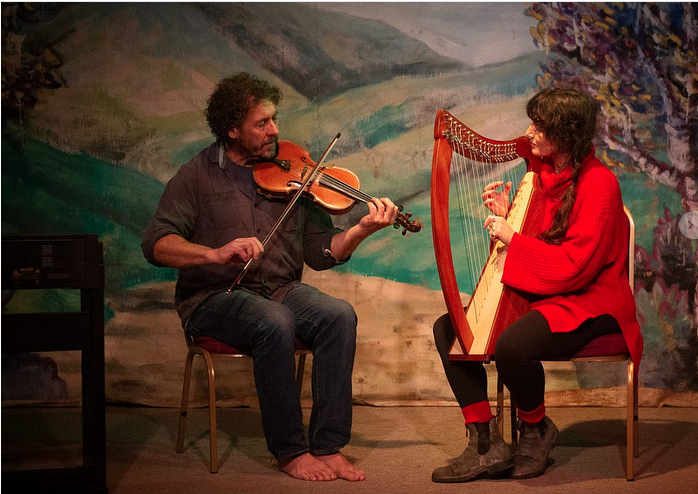
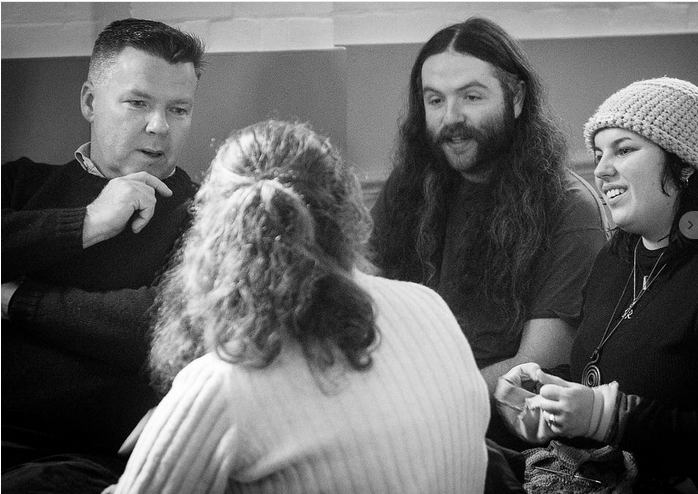
We then had time to chat amongst ourselves and find out a little of the journey we’d all taken to get here and quite what the motivation could have been.After that we had the first real time encounter with these new versions of the Carmina Gadelica with Natasha, Tristan and myself (we’ve been hearing them here for that last weeks). I wish I could tell you we painstakingly created that backdrop but it was already here. Natasha’s compositions were absolutely gorgeous, and Tristan’s fiddle is a roguish hint of heaven, right here amongst us. We need music! The room deepened around us again.Mind-Blowers: Natasha and Tristan
The afternoon finished with a deep dive into the story of The Voyage of Brendan: a pilgrimage to the hidden country and the story that kicked off Beasts and Vines almost four(!) years ago.
How do we dive as soulfully deep as Jasconious, roam as spirit-high as the angel-birds, dwell as deeply silent as the hesychastic monks? What Book of Life like Brendan are we quietly creating? What exactly is the hidden country?
Well by now darkness had settled on Walsingham and we took these questions out into the wider village for a few hours. Time for food and reflection. What would the fields and the tavern and the stars have to say about what we are brooding on? Medieval Brigands
By 7pm we had lit the incense, sparked the candles, and smiling pilgrims slipped back in and shook off the night, hopefully restored, and well fed. There were more glorious reels, jigs and a spell-binding ballad from Tristan and Natasha, then we were into a night of story. I began with a couple of personal tales of when strange providence landed in my life, and asked for us to track our own narratives where events greater and more wonderful than our own ambitions announced themselves.
Asmodeus the Destroyer of Love
The big tales were Joseph in Egypt and Blind Tobit. Both have something of an Underworld journey in them, Joseph down in a variety of pits and seemingly endless testings, and Tobit blinded as an old man and thrown into despair. In Tobit there’s a woman called Sarah who’s had seven potential husbands strangled on their wedding night by a terrible demon called Asmodeus.
Sarah wants to know love, but this demon-of-lust (that’s his particular role) keeps killing the men. Every time we are beset by factory-formed pornography rather than fulsome mysteries of real love, Asmodeus could well be involved. Good to be able to name him. All these tales have an initiatory resonance to them (including Brendan) and my invitation was to go and work with an image or two from the story that speaks most specifically to you. Be light with it, see where it takes you.
Well, finally our time together was at a close. Pilgrimage to Walsingham, story, song, conversation, it was glorious. People have asked me what my highlight was, I find myself saying it was a feeling rather than a moment. This could really be something.
Why are we doing all this? To become real human beings I suppose. Old growth people. To have a wider bandwidth to the still, small voice. To be fully storied by the great God of the storytellers.
The next morning many of us worshipped at local churches, and there were a few final goodbyes in The Black Lion before the spluttering, rarely spotted bus to King’s Lynn, or Cambridge, Stamford or far further afield. It was precious, suddenly spotting a new friend striding out into the Norfolk fields with a rucksack, or a cheery wave as they squeezed into a car full of travellers as the light started to fall. You wanted everyone home safe.
Later it was night and the village was suddenly empty, I sat on a bench under the high blue stars.
I watched my breath frostily puff out into the darkness. Winter. I rubbed my eyes as if coming round from a great slumber. This is still a wonderful world, and opportunity as well as peril, is everywhere. And I thought about you. Where will your pilgrimages take you? To the tree by your window may be plenty. Keep an eye for the Merrie – much is cooking.
Posted with kind permission of the author.